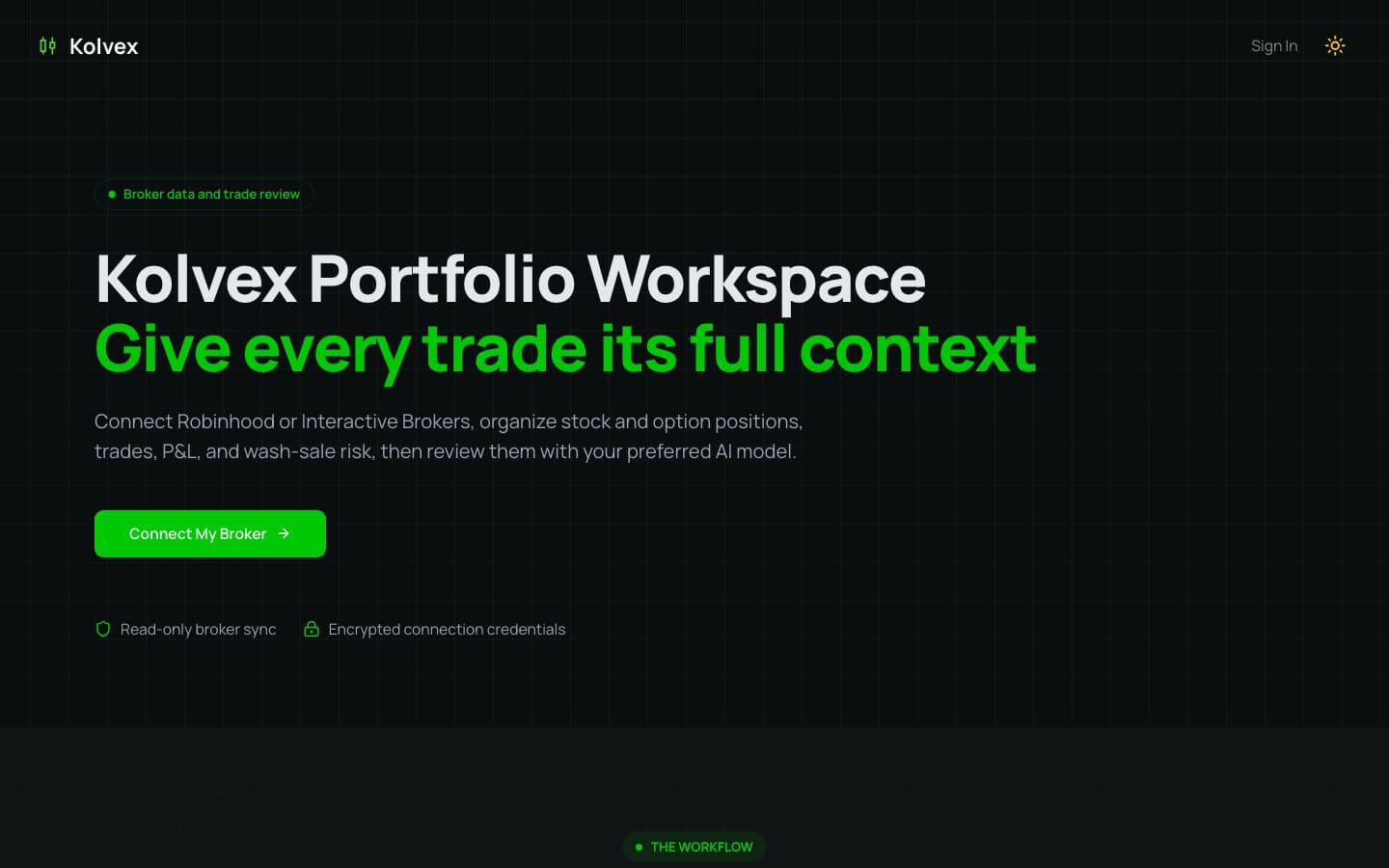
Kolvex.app is a portfolio workspace that gives every trade its full context. Traders connect Robinhood or Interactive Brokers with read-only access, then review holdings, stock trades, option activity, realized and unrealized P&L, and wash-sale exposure in one place.Selected transactions can be carried into AI Markdown trade review, stop-loss and take-profit planning, and strategy backtesting using the user's preferred model. Connection credentials are encrypted, and broker access stays read-only so the product can organize an investment record without placing trades.
Key Features
Read-Only Broker Sync:
Connect Robinhood account sync or official IBKR Flex, then pull holdings, stock trades, and option activity into a single workspace.
Portfolio and Risk Review:
Surface realized and unrealized P&L, sell timing, current wash-sale risk, and post-sale performance so users can see what happened after a close.
AI Trade Review:
Send selected trades into Markdown analysis with user-provided keys for OpenAI, Anthropic, and other providers, instead of locking the product to a single model.
Process Improvement Tools:
Pair quantitative risk plans with stop-loss / take-profit workflows, CSV export, history filters, and strategy backtesting.
Encrypted Credentials:
Store broker connection secrets encrypted at rest, with tenant-scoped records and session handling through Supabase Auth.
Market Context Layer:
Keep the same product surface connected to charts, news, and social signals so a trade review can sit next to the broader market picture.
AI: User-configured OpenAI / Anthropic (and other) API keys for trade review
Deployment: Vercel (frontend) + Railway (API), PWA support
Architecture Highlights
1. From Broker Connection to Trade Review
The product is organized around a four-step workflow:
Connect a Broker → Robinhood or IBKR Flex with encrypted credentials
Sync Your Portfolio → daily holdings, stock trades, and option activity
Review Risk and Performance → P&L, wash-sale risk, post-sale review
Improve Your Process → AI Markdown review, risk plans, and backtesting
Broker payloads are normalized into a shared holdings and orders model so Robinhood and IBKR data can be merged, filtered, and exported without the UI knowing which source filled each row.
2. Hybrid Rendering & Performance
App Router + Server Components for marketing pages, SEO metadata, and first paint
Client Components for the authenticated portfolio workspace, filters, and live sync status
Supabase SSR for cookie-based sessions across Next.js server and client boundaries
The public site stays fast on Vercel, while long-running broker sync and AI review jobs run on the FastAPI service.
3. Secure Broker Data Isolation
Kolvex treats broker credentials as sensitive user data:
Read-only broker connections; the product does not place orders
Encrypted connection credentials stored per user
Supabase Auth sessions with RLS on portfolio, order, and settings tables
User-owned AI keys so model access is not shared across accounts
Challenges and Learnings
Broker Authentication:
Robinhood device-approval flows and IBKR Flex token handling required session restore, refresh, and clear reconnect paths when a cached session expired.
Multi-Broker Normalization:
Stock orders, option orders, and account-level holdings arrive in different shapes. A shared order model plus merge-on-read made wash-sale and P&L views consistent across brokers.
Wash-Sale Visibility:
Users needed current wash-sale exposure, not just a historical tax export. Risk symbols are derived from synced fills and shown next to the transaction list.
Bring-Your-Own AI:
Trade review works with the user's preferred model. Provider keys stay on the account, and the review output is Markdown so it can sit beside the original fills.
Outcome
Kolvex.app is live at https://kolvex.app as a production portfolio workspace:
Read-only Robinhood and IBKR Flex sync
Unified holdings, stock, and option transaction history
Realized / unrealized P&L with wash-sale risk listing
AI Markdown trade review using the trader's own model keys
Encrypted credentials and tenant-scoped portfolio data
The project shows how a Next.js + FastAPI + Supabase stack can turn scattered broker data into an investment record that is easier to review and improve.